

Seven Marketing Predictions for 2026
The new year is nearly upon us, so what does 2026 have in store for marketers and brands?
Here are seven predictions of trends we think will be at the forefront of marketers’ minds in the coming year.
1. Multi-Platform Cohesion
Consumers dip in and out of content on Instagram, TikTok, YouTube and others as part of their daily lives; in fact, recent research suggests the average adult uses just over six platforms. If those people encounter your brand on any one of these platforms, they need the messaging to feel consistent.
This is nothing new for marketers – the art of devising a strong brand identity, and communicating a compelling brand story across multiple channels and touchpoints, has been at the heart of effective marketing since long before the advent of social.
However, where mistakes tend to arise on social, is in the eagerness to be too platform native. Yes, it’s vital that content suits the platform where it is being deployed, but it still must be true to the brand. The best social media marketers understand how to walk this line, devising content that works for the brand – ensuring consistent messaging and building brand familiarity for consumers – while feeling platform appropriate.
It’s also worth noting that this proliferation of platforms doesn’t mean you have to be present everywhere. Unless money and time are no object, most brands are better served focusing on a few key platforms than spreading themselves too thinly.
2. Social Search is our New Normal
Where people are searching has been fragmenting for the last few years, with AI changing consumer behaviour even more, but there’s no question that social search is now very definitely the norm.
We’ve examined GWI data over recent years to understand which platforms UK adults are most commonly using to find information about products and brands and the results are interesting. While Facebook, Instagram and Pinterest have seen only minor fluctuations – and Facebook and Instagram remain the most widely used – the percentage of people using TikTok for brand and product research has increased a whopping 294%, from 5.1% at the end of 2020 to 20.1% in Q3 2025. If this trend continues, TikTok is soon going to reach, or even overtake, other platforms for brand and product discovery.
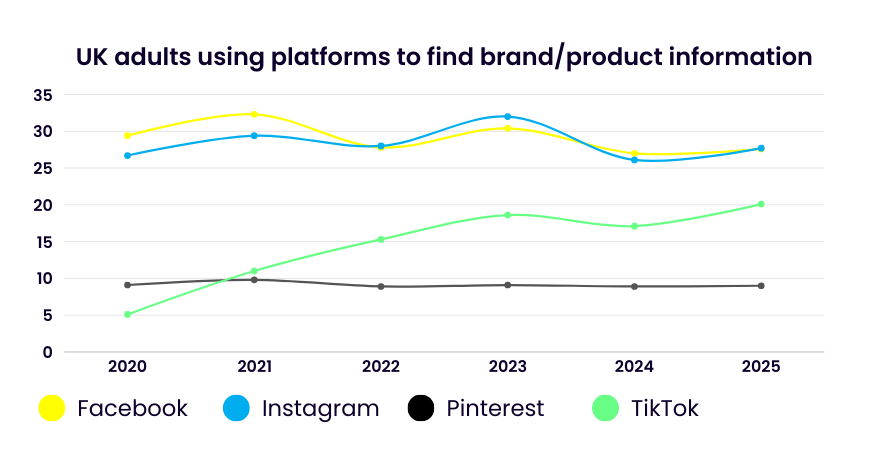
It’s also important to recognise the generational differences that exist within these patterns. Almost half (45%) of gen Z already use TikTok for product research, along with 27% of millennials. These groups are also more likely than older ages to be turning to Pinterest and Instagram (although a not insignificant 22% of gen X uses Instagram for brand/product research). It’s only Facebook that sees significant activity from all age groups, demonstrating its value for brands looking to target the valuable baby boomer market.
The important point is that the days of optimising just for Google are over. To be discoverable on social, it’s crucial to optimise in-platform too. You can read further advice from our senior social media strategy director Alex Dixon about social search visibility here.
3. AI: But in What Ways?
I can’t remember when I last read, or wrote, a list of annual predictions that didn’t include AI. For the last few years, it felt like we were all predicting something but couldn’t quite grasp what it would mean for our industry. However, 2025 has been the year when AI became less of a theory and more of an everyday reality, as people started to embrace the ways it can assist with daily tasks.
That said, it’s evolving so quickly that anything we predict today could be wildly far off the mark of where we might find ourselves in 12 months’ time.
What we do know, and what matters when we’re thinking about PR and social are two key areas:
Firstly, the impact of AI is undoubtedly being felt in the publishing world and its impact on traditional media outlets is ramping up.
Secondly, GEO is going to be talked about more and more in the coming year and great PR may prove to be a marketer’s best friend in the era of AI search. For a PR agency like us, that means the relationships we have with journalists are more important than ever for securing that all-important earned coverage. Although best practice in this field is still evolving, what is clear is that the sort of long-term, consistent brand building, thought leadership, and stakeholder positioning work which PR does so effectively is exactly what’s needed to stay relevant in the AI search landscape.
4. Connecting for Big CulTural MOments
In 2026, brands should be focusing on developing novel content, rather than relying on trends to provide content inspiration, but that doesn’t mean there won’t be big cultural moments that are worth tapping into.
As shared cultural life becomes more fragmented, with people finding their tribes online and fewer mainstream media events capturing widespread public attention, the events that buck this trend offer valuable opportunities for brands.
Some of these moments are firmly fixed in the calendar: expect lots of brand activity around the World Cup in summer 2026. If you’re after inspiration, check out some of our favourite sporting PR stunts from previous years or chat to us about ideas.
But other big cultural moments can be harder to predict. Looking at 2025 Google trends data for the UK, three of the top 10 ‘When is…?’ search questions related to Traitors – and while we might have predicted Celebrity Traitors being popular, I’m not sure many people expected it to be quite such a huge watercooler moment. To leverage these opportunities, you need an agile, responsive PR and social strategy that gives you the scope to act while the story is hot.
5. Don’t Neglect Community Management
Every marketer knows that retaining happy customers is more cost-effective than acquiring new customers. So, customer satisfaction shouldn’t be neglected by marketing teams and yet it all too often sits at a slight remove. Where customer service and marketing most obviously overlap in today’s market is in social communities. Marketing teams are busy ensuring they keep feeding the algorithm with great content, but is the same attention being paid to community management?
Consumers – many of whom are frustrated by the removal of traditional lines of customer-brand communication – frequently turn to social to get the answers they need, and they expect those answers to be timely and on brand. In the next year, if you don’t have a comprehensive community management plan in place, make sure it gets added to the to do list if you want to retain your existing customer base, build brand loyalty and, ultimately, turn happy customers into brand advocates.
6. Being Ready for the Unexpected
Nobody wants to start the new year with negative thoughts, but some of the biggest commercial stories of 2025 centred around cyberattacks on major brands. Disruptive actions like these appear to be on the rise and it’s a timely reminder for all businesses about the need for rigorous system security.
However, as well as these major attacks, brands need to be vigilant to the potential damage that disinformation and AI hoaxes can do to brand reputation. The nature of social media means that even minor issues can quickly blow up and spread like wildfire. So, having a robust, comprehensive crisis communications plan in place is a vital safety net in case the worst does happen.
7. Generation Alpha Turns 16 – Are You Ready?
Admittedly not every brand needs to be thinking about how to appeal to gen alpha right now, but this incredibly brand-savvy group is going to be keeping marketers on their toes in the coming years. We’ve previously explored what makes generation alpha unique, and what we’re learning as they mature is that they’re not just going to be mini gen Zs.
They’re also already very active online, with Ofcom reporting that over half (58%) of UK children are making online purchases. While a significant proportion of these purchases are likely to be within gaming spaces, GWI data backs up this trend with research showing the share of 12 to 15-year-olds buying products online each week has increased in the last few years, reaching 21% in 2025.
This is a digitally active audience that is already heavily using platforms such as YouTube and Snapchat. With the under 16 social media ban now in force in Australia, it will be interesting to see how the debate progresses around potential harm and how to protect under 16s during 2026. For brands that want to engage this audience, there has to be an inherent duty of care in how, where, and when to reach them.
The biggest takeaway, when we start thinking about gen alpha, takes us neatly back to my first point and the need for a cohesive approach whenever a consumer comes into contact with your brand. Gen alpha already isn’t distinguishing between traditional and emerging media in the way that previous generations might have done. They’ll do some stuff IRL and some stuff in a digital or virtual space and brands will need to meet them there.
In Summary
So, there you have it. In 2026, marketers will be spinning plates once again as we deliver strategic and creative activity across multiple channels and platforms, embrace and adapt to AI, connect with our online and offline communities around cultural moments, and make sure we’re ready for both the unexpected and the consumers of the future.
The author: Jane Ainsworth is managing director of WPR. She has over 20 years’ experience in developing and delivering communications strategies for consumer brands including Dunelm, Tesco, Mothercare, Greene King, John Lewis, Bullring, Beaverbrooks and Westfield.

WPR is an award-winning PR agency, based in Birmingham, delivering world-class PR and social media which makes ambitious brands impossible to ignore.
We specialise in consumer PR, across sectors including food and drink, retail and leisure; B2B PR, where we work with companies spanning manufacturing, construction and HVAC industries; and social media.
To start a conversation about how we can get the world talking about your business, please get in touch – we’d love to chat.